Role
Lead UX Designer
Product
Web Platform, US & UK
Timeline
Q1 2025-Present
Industry
Healthcare
Note
Scrap two siloed Medical Information and Medical Affairs platforms, and build a centralized experience. One unified hub for publications, product information, disease education, congress materials, and more, designed for time-strapped healthcare professionals.

Medical Information (MI)
CORE DEFINITION
The clinical and scientific content pharmaceutical companies are required to provide to healthcare professionals: dosing guidance, drug interaction data, clinical trial results, therapy area education, and more.
Clinical Trials
Dosing Guidance
Drug Interactions
Education
Medical Affairs (MA)
STRATEGIC FOCUS
Focuses on strategic, high-level scientific engagement, evidence generation, and Key Opinion Leader management. For HCPs, this content doesn't just inform, but it directly shapes patient care.
Strategic Engagement
Evidence Generation
KOL
Management
HCP surveys and internal audits gave us the qualitative layer. Our internal audits in particular gave insights into the usability and accessibility failures behind those numbers. All sources informed where we focused our design efforts
Discovery Survey Insights
52%
of HCPs consider pharma medical websites a critical source of scientific content
92%
contact a pharma company's medical information service up to 5 times every 6 months
80%
of oncologists access prescribing and dosing info during or between patient consultations
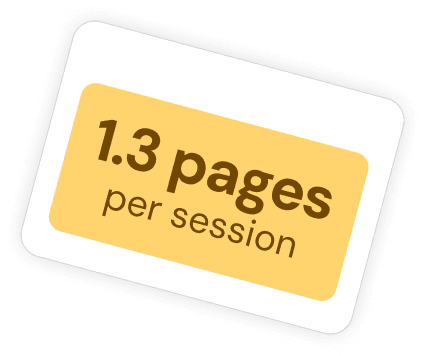

Analytics Insights


Legacy site screenshots
I led UX across the platform's most high-impact features:
Search Mechanism
The platform's core use case. End-to-end ownership from concept through stakeholder alignment and delivery
Search Results Page
Content hierarchy, dynamic filtering, and tagging logic
Congresses Experience
Redesigned filter logic and layout system
Meraki Design System Integration
Collaborated directly with Pfizer's system team, proposing and introducing new components
While two designers led other areas of the platform, I owned the search system from early concept through stakeholder alignment, iteration, and delivery.




Many, many iterations of the search experience
Project Workflow
Every decision needed sign-off from client, regulatory, and engineering teams. So that was fun. The constraints meant we had to focus on the essentials, and make some trade-offs along the way.
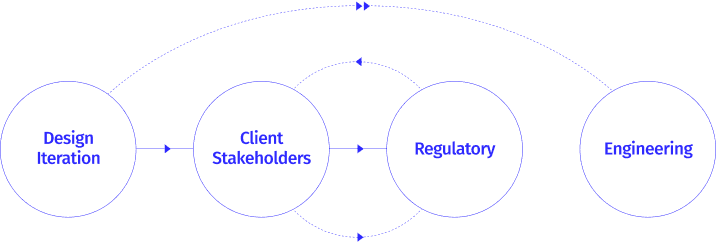
Team workflow snapshot


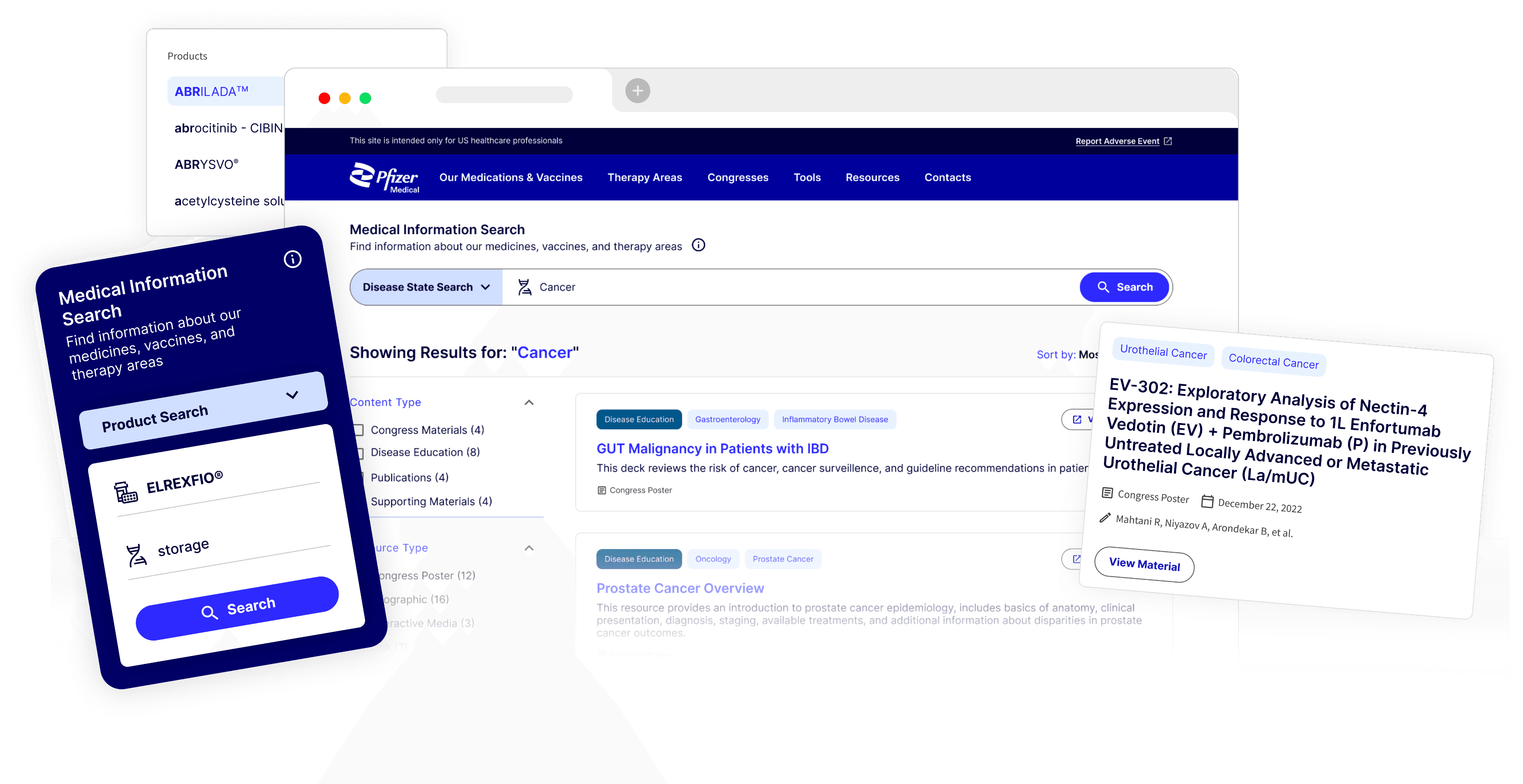
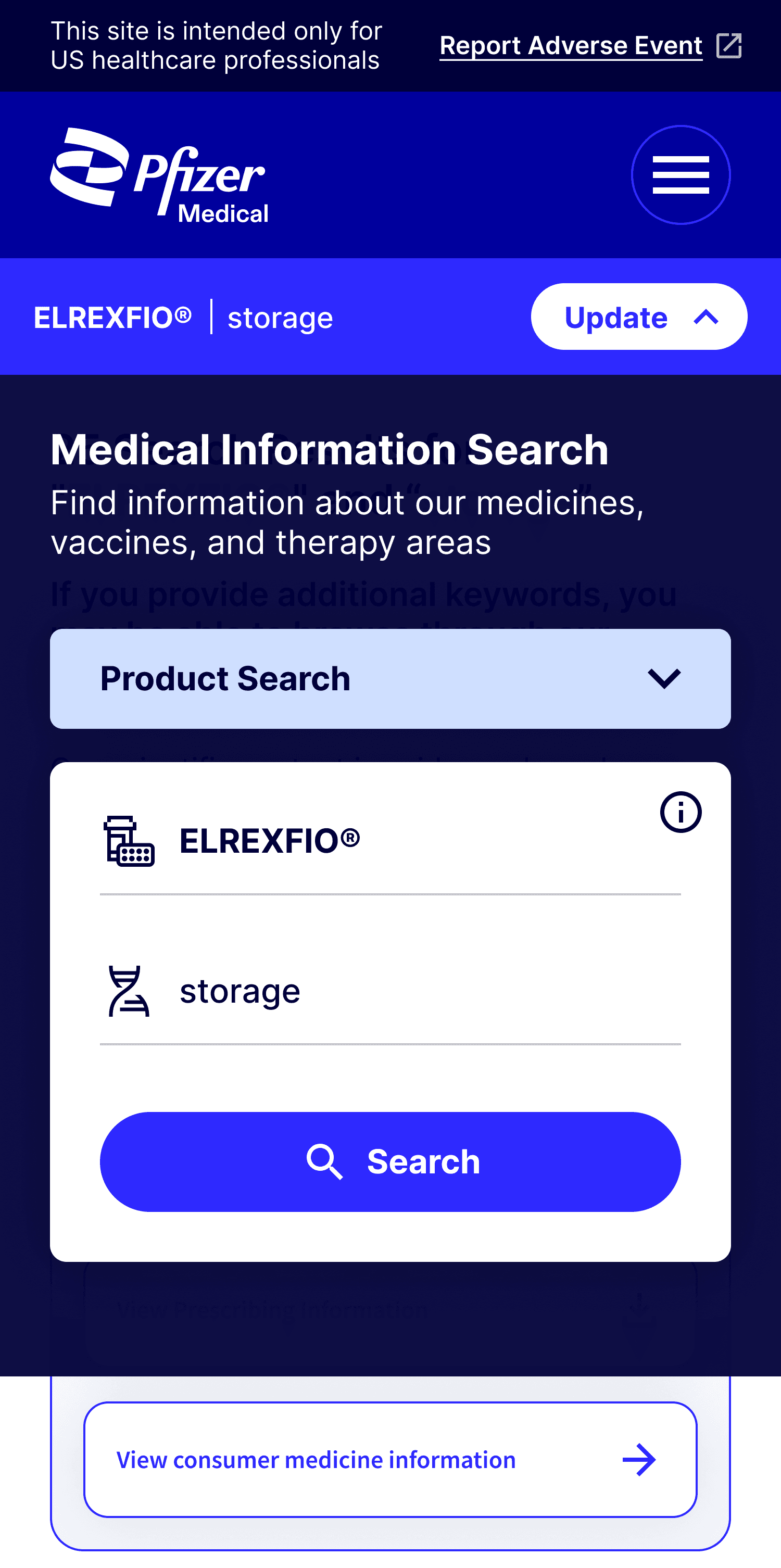
Segmented Search
A search drawer accessible from anywhere on the site, letting users toggle between query modes: product, disease state, and beyond. Built to scale, so new query types can be added in future phases without rebuilding from scratch.
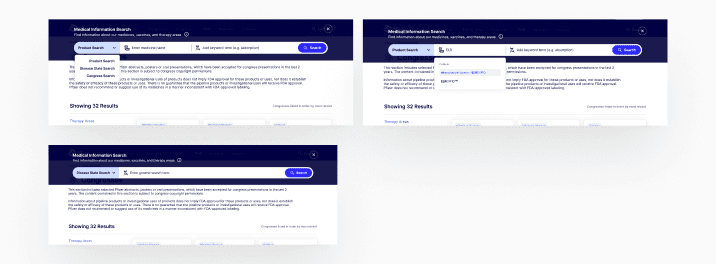


Search mechanism examples
Search Results & Filtering
Results tagged by content type, paired with a dynamic filter panel. HCPs can scan through thousands of assets by therapy area, indication, file type, and more.


Result Card Anatomy
The result card structure was carefully considered. HCPs often have limited time, so we need to ensure that each result communicates the most important information at a glance.


Breaking down the anatomy of a result card
Congresses
A redesigned layout and filter system giving HCPs fast access to congress schedules, materials, and session content. Improved signposting and hierarchy.


Mobile Experience
HCPs aren't always at a desk. Research shows more than a quarter of HCPs spend three or more hours a day accessing clinical resources on their smartphones, and mobile drug referencing is one of the most common on-the-job use cases. The platform was fully optimized for mobile, with every core interaction thoughtfully adapted for smaller screens.


Phase I unified two legacy platforms across two markets into one cohesive system. The foundation is built to grow, with personalization, chatbot integration, and AI-assisted search on the roadmap for Phase II and III.
What we’re tracking post launch:
Bounce rate — targeting a significant reduction from the 82% baseline
Pages per session — measuring deeper engagement beyond the 1.03 avg
Search completion rate — % of queries that result in a content interaction
Time-to-content — how quickly HCPs reach what they came for
Return visit rate — a signal of platform trust and utility
Note
This is a condensed version of the story.
Reach out at alvarado.alyssa08@gmail.com for the full case study!

